
[real3dflipbook id=’1′]
https://dario-cortese.medium.com/an-introduction-to-syntropic-agriculture-9a346050e6ed
There has been lots of talk, in regenerative agriculture, about syntropic agroforestry. Many of you will have noticed that there is very little (written or video) English material available for those who would like a systematic description of the basic concepts and underlying principles of this method. Throughout the last year, I have been researching syntropic agriculture as an external observer, in order to understand this method — that is inspired by the observation of the indigenous populations of the Amazon, and was formalised and brought to the West by the pioneering work of Ernst Gotsch in Brazil and Portugal.
This post and the ones that follow are an attempt to offer my personal perspective on the topic, with no intention of being authoritative or comprehensive. I haven’t had the pleasure of managing a syntropic system nor meeting Ernst personally yet. The information that I have gathered is the result of several conversations with colleagues and friends who have worked extensively on syntropic systems, as well as watching interviews and reading books, notes and other material available in Portuguese and English.
The syntropic or successional approach to agroforestry outlines a way of interacting with ecosystems which marks a step in the right direction: the ecological (not social/cultural) indigenisation of humans and agriculture. If we put aside cultural factors, what is the biological and ecological role of humans within the ecosystems they are part of? Is it possible to attune what we call agriculture to the processes that humans would engage with in the wild, as part of a complex and dynamic ecological mechanism? As I see it, the uniqueness of Syntropic agriculture lies in this ecological perspective, as opposed to the utilitarian and culturally anthropocentric one which is typical of modern agriculture. That such an approach should strike us as revolutionary gives us a measure of our deep separation not only from our ecosystemic role, but also from the integrated relationship that indigenous cultures have with the land.
1. Ecological succession
Before we can even start to talk about syntropic agroforestry, I believe it is necessary to have a clear understanding of one of the most fascinating and totally spontaneous processes that take place on our planet: ecological succession.
Colonisation
In the wild, a degraded soil gets quickly colonised by a diverse series of plants, animals and microorganisms. Initially, microbes are the only life forms, and they start to make the minerals contained in rocks soluble; they also increase the availability of oxygen and CO2, thus preparing the ground for plants. The first plants are herbaceous (i.e., without woody tissues), these include ephemeral, annuals, biennials and finally perennials. They are able to adapt to extreme conditions, such as low fertility and water availability. As pioneers, these plants fulfil their role by accumulating minerals from deep down the soil profile; they partner with bacteria including nitrogen-fixing ones; they add organic matter to the soil both by root exudates and with their tissue when they die for the winter or at the end of their life cycle. This phase can be named “colonisation”, and (in syntropic jargon) it represents the “placenta” of the ecosystem.
Accumulation
With their work, herbaceous plants prepare the soil for the arrival of more complex species, such as pioneer shrubs and trees. These usually arrive into the system via the wind. Shrubs and trees carry on accumulating and cycling minerals and organic matter on the surface of the soil, adding in the lignin contained in their tissues — a compound that decomposes a lot more slowly than cellulose and induces humification (the creation of humus, or stable organic matter). The resulting organic material creates an ideal food and habitat for fungi; these, in turn, respond by intensifying their mycorrhizal network through which plants communicate and trade nutrients. Shrubs and trees are also more effective at improving soil, because of their deeper roots and their ability to provide shade during the hotter months, thus creating less extreme conditions for plants in the undergrowth. As a result, herbaceous pioneers start to be less abundant and are replaced by more demanding plants, more similar to our common vegetables and thus rich in carbohydrates and proteins.
This is the accumulation phase. What is being accumulated is natural capital, measured in terms of biodiversity, the complexity that characterises the relationships among the living organisms present in the system, and the forms in which energy is being stored (fertility, organic matter). Such an accumulation corresponds to an increasing level of organisation, which can be technically defined as syntropy (or negentropy) — the inverse of entropy, the quantity that measures the level of disorder characteristic of non-living systems.
The accumulation phase marks the arrival of the first fruiting plants; these represent a source of complex sugars that enriches the food dynamics within the ecosystem, and also attract larger animals into the system, birds and mammals in particular. Medium and large size animals (wild bore, deer, etc.) fertilise the soil with their droppings and create ecological niches with their disturbance action, thus allowing the system to further increase in complexity. Mammals and birds also bring the seeds of more demanding plants, such as fruit and nut trees, which indicate the approach to the abundance phase.
Abundance
The abundance or climax phase is characterised by plants which populate all the layers or strata of three-dimensional space (low, medium, high, emergent), as well as having a diverse range of life-cycles (ephemeral, annual, perennial). Above all, we see an increase in diversity, complexity and the accumulation of energy in the form of organic compounds: humus, protein, carbohydrates, sugars, fats, etc — both above and below ground. Typical of this phase are fruit, nut and timber trees, productive climbers, starch-rich roots and a diverse fauna including mammals, reptiles, birds, insects that feed on vegetables and predate on one another.
Thus, the stability of the ecosystem has increased alongside three main factors: biodiversity (of microbes, plants, animals); complexity in the interaction between all the elements (trees communicating via mycorrhizal networks, food chains above and below ground, etc.); and finally soil fertility. The latter is the common thread throughout the entire ecological succession, because it is in the soil that all the efforts of the initial phases focus; and it is in the soil that minerals, organic matter, water and the main core of biodiversity are developed over time.
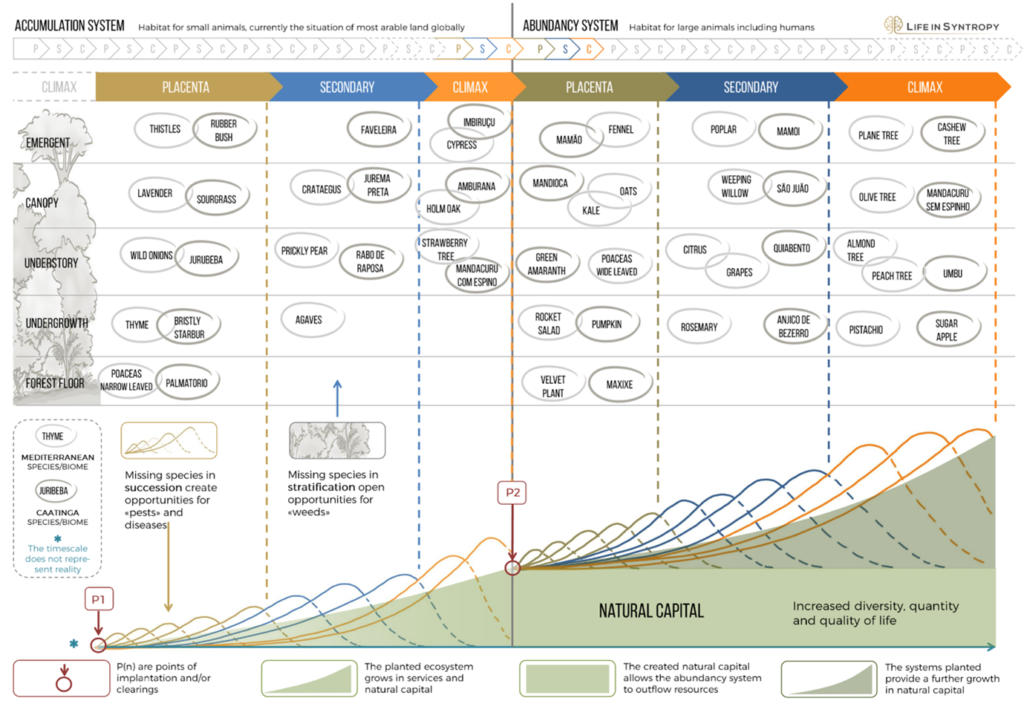
Dynamical equilibrium and patch dynamics
This is clearly a simplified view of one of the most important and defining processes that take place on earth. In fact, each phase has within itself a level of colonisation, accumulation and climax. Some species act as turning points within this internal dynamics. Brambles (Rubus fruticosus) are such an example. These establish themselves as a pioneer shrub, towards the end of the colonising phase; they spread fast by letting the tip of their arching branches root into the soil. With their flowers, brambles attract pollinating insects, and with their fruits they entice birds that introduce the seeds of more demanding species with their droppings. The shrub and trees thus imported germinate among the brambles, protected from herbivores by their vicious thorns. Thanks to this characteristic behaviour, brambles colonise gaps within woodland and field edges, thus marking a turning point between herbaceous and tree species, as well as between tough and delicate ones.
This process can take place also in a mature ecosystem, whenever a gap is created by the disturbance caused by an animal or a geological or climatic event. In such gaps the soil gets disturbed and the level of light is typical of an earlier ecological phase compared to the surrounding areas. When this happens, the neighbouring patches and the existing soil act as an inoculant of biodiversity and fertility, thus stimulating a repopulation of the gap which is faster and adds additional complexity to the entire ecosystem. This process (called secondary succession) repeats itself at random intervals, thus creating a patch dynamics that makes the ecosystem resilient and characterised by a dynamical equilibrium, maintained by an alternation of disturbance and consequent accumulation of natural capital.
A mechanism, in particular, is worth highlighting within this process. Whenever a plant gets damaged, pruned or eaten, it directs carbohydrates from its aerial to its underground parts. This stimualates and influences the microbiological action in the root zone, and where mycorrhizal networks are well established, a biochemical signal (which some believe is mediated by the plant hormone gibberellic acid) is sent to the surrounding plants. This combined microbiological and biochemical/hormonal stimulation has a triggering effect on the surrounding plants, which experienced more nutrient availability, and are stimulated to grow more vigorously, photosynthesise more and set more flowers and fruits. Thus, when the canopy of a plant is pruned, not only light is introduced to the lower layers, but a “growth pulse” is propagated into the system, and felt by the neighbouring plants.
When the first westerners colonised North America, they reported that after clearing a forested area, for a few years they were blessed with the best soil and growing conditions they had and would ever experience. What they were doing was creating a gap in a well-established ecosystem. In the gap, soil is at its peak fertility, the extra light creates the perfect conditions for vegetable and fruit production, and the pulse generated by the felling and the pruning enhances this effect. If one were to plant young trees alongside vegetables in such a gap (like indigenous Amazonian tribes used to do) this would gradually recreate forest conditions in that same patch. Then a new patch can be cleared, thus effectively growing light-, water- and fertility-demanding crops within a forest, without affecting the stability of the latter. This eye-opening realisation lays the basis for a way of growing vegetables that is in harmony with natural processes.
2. The principles of Syntropic agriculture — a taster
Syntropic agriculture is rooted in the careful observation of the ecological and physiological phenomena described above in various geoclimatic contexts. The syntropic approach is focussed on preserving these mechanisms and take advantage of their spontaneous character to trigger and accelerate the process that leads from a degraded, disturbed or ordinary soil to an abundant ecosystem.
The theoretical framework of syntropic agriculture is founded on a series of principles that codify natural, ecological processes and make them utilisable in productive contexts.
It is indeed possible to mimic natural ecosystems closely. If we observe the successional dynamics discussed in the above, we notice that a living system develops its complexity, diversity and fertility over four dimensions: space and time. Energy is stored in the form of organic matter and resilience is built upon complexity and functional redundancy. Throughout the ecological succession process, an ecosystem increases its level of organisation, encoded in the physical quantity called syntropy. The increase in syntropy is a lot less common in the Universe than one might realise, and only living systems show a marked tendency to do so, while inorganic ones always tend to a constant increase in (internal) entropy.
A formal theory of syntropy was proposed by one of the most talented mathematicians of his era — Luigi Fantappiè. In the 1940s, he started working on a unified theory of biology and physics, which would have Einstein’s relativity as a limiting case and the origin of life as natural emergent phenomenon. His theory was based on the interaction of syntropy and entropy, and the existence of three levels of time. I won’t go into this (very complex and controversial) theory, which costed Fantappiè his reputation, but I will leave it to the interested reader to delve deeper into his fascinating elucubrations.
In practice, syntropic practitioners have developed a series of techniques that reproduce what would happen in the wild, but using design and observation to accelerate the ecological processes and make the resulting system highly productive.
In particular, by studying ecological succession, it is possible to become increasingly independent on external inputs: after all, the succession process described above only needs a few microbes, a mineral soil, water and solar energy to trigger a series of transformations that leads to mature forest. In syntropic approaches, then, it is pointed out how external inputs, if necessary, can be kept to a bare minimum, because the plants themselves are used to create fertility via photosynthesis and their microbial partnerships. The regeneration of agricultural ecosystems involves the accumulation of fertility in the form of biomass (which gets ideally converted into stable soil organic matter), and microbiological diversity and activity. This accumulation can be delegated to pioneer plants which get chosen, planted and pruned strategically, to mimic what would happen in the wild and dramatically accelerate the process of ecological succession and enhance the resulting abundance. Such a process would take place anyway, but on much slower time scales compared to what we aim to achieve in agricultural systems.
By engaging in this strategy, humans reclaim their role as large mammals, whose function is mobilising and cycling organic matter by interacting with a multitude of trophic levels within the ecosystem. This has two consequences. Firstly, the humble recognition that we are not the only intelligent component of a mechanical system, but we are part of a system that is itself intelligent. Secondly, the development of a series of techniques that leverage the spontaneous character of ecological processes.
Such techniques are based on some key principles:
- Plant consortia or interplanting combinations
- Four-dimensional stratification in time and space
- Planting and selective/strategic pruning of pioneer plants that fulfil a service role (humification, shading, accumulation and cycling of water, biomass creation, habitat for insects and microbes)
- Application of the principles of regenerative agriculture: avoiding synthetic chemicals and soil disturbance, keeping the soil covered, encouraging biodiversity and maximising photosynthesis
- Concentration of energy and biomass production
So, how does a syntropic system work and how to establish one from scratch? How do we apply syntropic methods to commercial operations? These are questions for another post. Stay tuned!
The key findings are
- Farmers (project participants) have not received monetary benefits.
- Farmers have limited awareness about climate resilient agriculture and carbon credits.
- Two revenue-sharing models: In the first there is no revenue sharing as carbon project is built on existing watershed project for internal auditing; the second project shares revenue with farmers.
- Local implementation partner is important for effective project execution.
- Local community experienced social benefits such as improved water availability, increased Rabi season cultivation and women participation in agriculture.
- Initial adoption of sustainable practices was incentivized by discounts on services such as drone pesticide application.
- Project developers feel that lack of a regulated market, low prices and lower demand for Indian carbon credits makes such projects financially unsustainable.
- Continued adoption is context specific. For example, abundant rainfall led to discontinuation of Alternate Wetting and Drying (AWD) in the Telangana project.
https://cgspace.cgiar.org/bitstream/handle/10568/134967/66684.pdf?sequence=1&isAllowed=y
ICRISAT and World Food Program have published a report quantifying climate change impacts on Indian Agriculture
Pulished by WIPO
by Manjunatha G, Sandeep Hanchanale, Veena Srinivasan on 4 October 2022
- Akkadi Saalu, a traditional intercropping system followed in Karnataka, encourages biodiversity on the farm and secures the yield from the farmland. It is traditionally practised on rainfed agricultural land as dryland agriculture.
- While the advantages of lower input costs in many natural farming systems are well documented, one common critique is that avoiding pesticides renders crops more vulnerable to pests. However, farmers following Akkadi Saalu view weeds favourably and pests with tolerance, instead of trying to destroy them.
- Multicropping gives farmers with smaller landholdings more security. There is less risk of losing all crops at once at a time of multiple intersecting risks, from erratic weather and degrading soils to unpredictable markets.
Prabhakar B. is a traditional farmer from Nangali village in Karnataka’s Kolar district. Along with P. Srinivas, popularly known as ‘Soil Vasu’, he leases degraded rainfed plots and converts them to biodiverse agroecological farms.
Prabhakar’s mother, Rajamma, also swears by the traditional farming practices and seed varieties passed on by their ancestors. “When I got married, my parents passed on these seeds to me, they told me to take care of them and that one day, the seeds will take care of my family,” said Rajamma. She said that they preserve their seeds with a great deal of care and do not use them during particularly harsh summers when drought-like conditions prevail over this semi-arid belt in Kolar. Rajamma considers a farm “an equal resource to all forms of life including pests and insects”.
The farm follows a traditional intercropping system followed in Karnataka called Akkadi Saalu, which encourages biodiversity on the farm and secures the yield from the farmland. It is traditionally practised on rainfed agricultural land as dryland agriculture. Akkadi Saalu is all about growing diversified crops – a mix of millets, oil seeds, pulses and other medicinal herbs along with greens and flower plants.
Large parts of agricultural land in Karnataka is undergoing degradation, affecting crop yield and farmers’ incomes. There is an urgent need to look beyond high-input monocropping systems and towards agroecological systems such as Akkadi Saalu, especially for small or marginal farmers whose precarious rainfed agricultural livelihoods are vulnerable to extreme weather events and pest attacks.
But what does Akkadi Saalu entail? How have Prabhakar and Vasu been able to keep his biodiverse farm thriving in a semi-arid landscape through this method? Based on our interviews and observations, we have documented the practices that they follow.
Creating farms that provide food, nutrition and fodder security
Akkadi Saalu was promoted keeping in mind that the crops may grow for two agricultural seasons – monsoon (kharif) and winter (rabi). This type of farming involves working with the land, the soil and the seasons. A variety of seeds are sown just before the first pre-monsoon rains. A couple of weeks after these germinate, the soil is turned over. This increases the organic matter in the soil but also ensures that the seeds of most weeds have germinated and been eliminated.
In the monsoon season, multiple crops are grown. The primary crop is intercropped with crops that have different growing periods ranging from 3 to 6 months. While the primary crop is grown for sale in the market, the intercrops and weeds are intended for home consumption. The inter-crops include crops like pigeon peas, millets, and oilseeds. Both hybrid and native seeds are used. The intercropping plants are usually placed in the periphery of each plot.
After the kharif harvest, the soil is turned over and the crop residue is mulched and the field is sown again with four or five types of seeds. The rabi crop is almost exclusively meant for fodder, for cattle. Generally, the hay produced on one acre is sufficient to tide three to four cattle over the hot summer season. One of the primary characteristics of the Akkadi Saalu method is the equal focus on food and fodder. The diversity of harvest timings ensure that benefits accrue at different times. The field is covered with crops for almost 8 months of the year relying entirely on soil moisture with no supplementary irrigation.
The discarded crop residue is used as manure for the main crops grown in the next season. The constant mulching ensures that all soil organic matter is conserved and soil is nutrient rich.

Focusing on soil health and moisture rather than irrigation
In the Akkadi Saalu method, earthworms and other soil organisms are used to create preferential pathways. The central principle of the method is that if soil biodiversity is conserved then the soil fauna will dig tunnels and burrows and create preferential pathways for the rainwater to infiltrate. Engineering studies investigating infiltration into soils tend to underestimate the role of biodiversity in determining soil infiltration characteristics. One of the critical aspects of Akkadi Saalu is therefore to preserve life in the soil and not use pesticides.
Additionally, differential root depths create pathways in soil in this method. The use of multiple plants for intercropping is not just for nutrition but also to boost nutrients (nitrogen fixation), soil carbon and soil moisture. The plants are specifically chosen for their diversity in rooting systems. Some have a single deep tap root, others have lateral roots and so on. Each of these root systems aids in filtration and spreading of soil moisture.
One of the common species used in intercropping is castor. Castor is an annual crop with large leaves, which grows to a height of about 6 ft by the summer. Leaving castor in the field over the summer months reduces bare soil evaporation and further conserves soil moisture. It is mulched again before the next kharif crop and the cycle begins again.
Because of the emphasis on high soil organic carbon and moisture, farms that follow Akkadi Saalu need very little ploughing. Farmers argue that the soil organisms act as tractors, keeping it porous and constantly turning the soil over.
Treating weeds as wealth and living with pests
While the advantages of lower input costs in many natural farming systems (including Akkadi Saalu) are well documented, one common critique is that avoiding pesticides renders crops more vulnerable to pests. Here, there is a fundamental philosophical difference: farmers following Akkadi Saalu view weeds favourably and pests with tolerance, instead of trying to destroy them.
American biologist Rachel Carson famously wrote in her seminal book, Silent Spring, 60 years ago, “One natural check is a limit on the amount of suitable habitat for each species. Obviously then, an insect that lives on a wheat farm can build its population to much higher levels on a farm devoted to wheat than on one in which wheat is intermingled with other crops to which the insect is not adapted.”
One of the striking characteristics of farmers who practise Akkadi Saalu throughout Karnataka, is the recognition that weeds provide direct and indirect benefits. Many rural farmers are able to recognise the medicinal benefits of weeds, which are used in soppu saru (green stew) and as fodder for their cattle. It’s common to see the weeds being taken home for dinner.
Resilience to pests is one of the much-touted benefits of a diversified farm. One of the key features of Akkadi Saalu is the use of ‘trap crops’. These crops are deliberately chosen to attract unwanted pests. The pests feed on trap crops and leave the main crops alone. Typical trap crops are oilseeds like castor. If there are enough trap crops, pests are able to complete their entire lifecycle on the crop. Other plants are bird attractors. The birds come and eat pests and the grain/fruit on the bird attractor plants leaving the main crop alone.
The principle of ‘leaving some for nature’ and using biocontrols is dramatically different from the conventional approach of killing pests. In the Indian context of small farm sizes, it may be effective, especially in the context of rainfed agriculture when farmers have to keep input costs under control.

Making a decent living off a single acre of rainfed land
The most important feature is that Akkadi Saalu may be more economically viable and less risky, than conventional agriculture, particularly in small rainfed plots. The key to the economic viability is that every single component of the groundnut is used and the farmer gets the benefit of the value addition, only paying a nominal processing fee for rental of the equipment.
For example, an acre of land yields about 700 kg of groundnut, which yields 230 litres of oil. Each litre will sell for around Rs. 400. Also the processed groundnut oil cake would be around 450 kg and it will sell for Rs. 50 per kg. So, if processing is considered inhouse, then total earnings would be approximately Rs. 1.12 lakhs (Rs. 112,000). This might not seem like much, but it is almost thrice what conventional ragi farmers make per acre.
Similar agroecological practices are followed across India
This form of intercropping is not unique to south-eastern Karnataka; Akkadi Saalu is the local name here. Similar traditional practices are still widely practised by farmers, who own small or marginal land holdings, across the country today. For example, Navadhanya in Andhra Pradesh. Mainly followed in the Rayalaseema regions of Anantapur and Chittoor, this poly-crop system caters to commercial markets through a ‘main crop’ and provides for domestic consumption by cultivating several varieties of pulses, oil seeds, vegetables and cereals. Traditional farmers in Andhra Pradesh and parts of Telangana also use the name Pannendu Pantalu to refer to cultivation of 12 different food grains on one plot of land.
The Himalayan states, including Uttarakhand, also follow a similar practice but they call it Barah Anaaj. The 12 crops that typically make up their method include ragi (millets), amaranthus, kidney bean, green gram, buck wheat, lobia (black eyed pea), horse gram and a few other crops.
In parts of Tamil Nadu, farmers who practise intercropping call it Oodu Payir. They mainly grow a combination of ragi, groundnut, horse gram, sesame along with field beans (Avare), cowpea, toor dal, black gram. Hangadi Kheti in Rajasthan, Gujarat and Madhya Pradesh; Kurwa in Jharkhand; Baradhanya in Maharashtra all refer to traditional forms of intercropping. This reflects the diversity of such practices that exist all across India, as smallholder farmers adopt unique cultivation methods and crop choices based on the soil and climatic conditions of where they are based. But some of the principles of preserving soil health, and managing weeds and pests remain the same.
Multicropping gives farmers with smaller landholdings more security. There is less risk of losing all crops at once at a time of multiple intersecting risks, from erratic weather and degrading soils to unpredictable markets. Rachel Carson had also written, “Nature has introduced great variety into the landscape, but man has displayed a passion for simplifying it.” Prabhakar’s 1.06-acre Akkadi Saalu plot is an example of what retaining ‘great variety’ looks like.
Veena Srinivasan is the Director of the Centre for Social and Environmental Innovation at ATREE, Bengaluru. Sandeep Hanchanale leads the Farms and Forests Initiative at CSEI and Manjunatha G is the Field Partnerships Associate. Additional inputs by Revitalisation of Rainfed Agriculture Network (RRAN) and freelance journalist, Mallikarjuna Hosapalya.
The authors met Prabhakar and Rajamma at a two-day soil training workshop, organised by CSEI-ATREE and the Rainmatter Foundation, and led by P. Srinivas Vasu, the founder of SOIL, a trust that focuses on protecting and rebuilding soil health.
Banner image: Prabhakar B. next to his plot of rainfed land in Nangali village in Karnataka’s Kolar district, where he practices a traditional form of intercropping called Akkadi Saalu. Photo by Manjunatha G.